(from Sequences magazine, September-October 2015, translated from French)
★ ★ ★ ★ ★
(from Sequences magazine, September-October 2015, translated from French)
★ ★ ★ ★ ★
Unofficially it was in 1938 with The Drum, and a year later with The Arsenal Stadium Mystery, that Miklós Rózsa (anonymously in both cases) began his film music career. Officially, his presence was confirmed on screen in 1940 with The Thief of Bagdad where he was prominent with those involved in the film's production, screenwriting and directing, and his participation gave him an introduction to the American film industry after he relocated to Hollywood because of the outbreak of the Second World War.
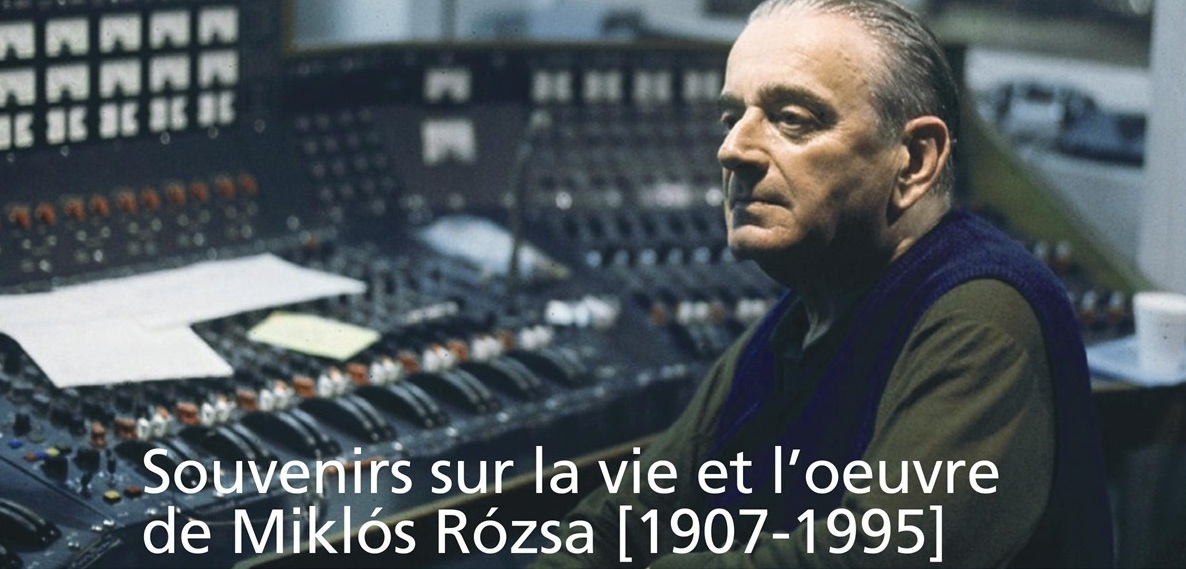
In his long career Rózsa composed, among other films, those which became paradigms: Spellbound (1945), Quo Vadis (1951) and Ben-Hur (1959). His style asserted itself, carving out a place of honor in the world of music for the Big Screen. On the occasion of Rózsa's death in 1995, our former collaborator and music critic François Vallerand paid tribute to him while explaining his own passion for film music. — Luc Chaput
★ ★ ★ ★ ★ It was in near-total media indifference that Miklós Rózsa died, on July 27, of pneumonia. While a few specialized publications, such as Variety and Entertainment Weekly, highlighted the event, only Time,among the major weeklies, briefly mentioned it in its Milestones column while misspelling the musician's name. Newsweek, for its part, ignored it completely, preferring to report the death that same week of Laurindo Almeida, a talented guitarist but minor composer, who also worked in many films, either as a soloist or as a composer of pieces for guitar, lute or mandolin such as Maracaibo, starring and directed by Cornel Wilde. The very short article published in Montreal's La Presse seemed a rather paltry tribute in view of the importance and the place that Rózsa had created for himself in the world of cinema as well as so-called "serious music."
Aged 88 at the time of his death, Miklós Rózsa had been ill for several years. Victim in the early 1980s of a cerebral hemorrhage that had greatly diminished his capabilities, he had nonetheless continued his activity as a composer, devoted solely to concert music. With Dead Men Don't Wear Plaid (1982), directed by Carl Reiner, he created his farewell to the cinema for which he had composed more than a hundred scores, starting with Jacques Feyder's Knight Without Armor (1937).
Curiously, all of Rózsa's work for the cinema is based on an astonishing paradox — he never hid his lack of interest and his distrust for this art form, although he was to become one of its most renowned and respected collective artisans. It is not disrespectful to his memory to say that he is today better known for his film music than for his works composed outside of cinema. Although he was a friend of all the famous names in music — conductors Antal Dorati, Charles Munch, Bruno Walter, Georg Solti, Eugene Ormandy, violinist Jascha Heifetz, cellist Gregor Piatigorsky, etc. — he paid the price that the world of serious music reserves for musicians who dare to venture behind the screen.
Guided and motivated by the example of his friend Arthur Honegger, it was partly out of the need to provide for his needs that Rózsa came to film music in the mid-1930s. If pure music was his first concern, he produced scores for the cinema that were in no way inferior in terms of inspiration to his concert works.
Throughout his life, he moved with ease between cinema and the concert hall, where he left an impressive catalogue of works exceeding thirty opus numbers. His memoirs, published in 1982, revised and reissued in 1989, bear witness to this preoccupation and bear the revealing title of A Double Life (inspired by the title of the psychological drama A Double Life (1948), for which he composed the music and which earned him his second Oscar).
In his autobiography, Rózsa reveals with consummate humor the twists and turns of a remarkable career which, however, did not always bring him only honors. Apart from the fact that his name was often spelled and pronounced incorrectly (Rózsa, and not Rosza, is pronounced "ro-ja"), he had to suffer in supposedly serious musical circles from his association with cinema. Writing one day about a performance of his Theme, Variations and Finale, op. 13, composed in 1933, and which had already made Rózsa famous in Europe at a time when he had not written a single note for the cinema, a very informed critic declared without batting an eyelid that the work undeniably bore the marks of the composer's involvement in film music.
Victim of the sarcasm of right-thinking circles, Rózsa was also the target of the musical departments of Hollywood studios and he had, more than once, a run-in with the narrow-mindedness or simply the cretinism of some of his bosses. A musical director at Paramount (whom Rózsa, out of kindness, always refused to identify) so despised the angular and dissonant style of his score for Billy Wilder's Double Indemnity (1944) that he told him in all seriousness that "it was music for Carnegie Hall." Rózsa, pretending to ignore the insult, let him know that he took that as a compliment.
Upon his arrival in Hollywood in the early 1940s, Rózsa had some acerbic words, which irritated more than one person, about the methods of composing film scores, which he compared to work on factory assembly lines. The musical style then in vogue — lyrical, romantic, avoiding any dissonance — was also the object of his devastating humor when he described it as "Broadway mixed with Rachmaninov". Although he found the orchestras very professional, he often had to intervene to impose a style of playing more in keeping with his style.
Correcting one day the syrupy playing full of tremolos and glissandos played by a studio violinist who justified himself by saying: "It's the gypsy in me," Rózsa replied: "No, my dear, it's the MGM in you." The violinist probably wanted to please the composer who was often called, probably in derision, the "Great Wagnerian Gypsy of Hollywood." However, Rózsa had no love for gypsy music in particular.
During a working meeting with John Green, the new musical director of MGM responsible for conveying the musical tastes of the management, the latter asked the musicians to write in a Steineresque or Coplandesque manner, in reference to the respective styles of Max Steiner and Aaron Copland. Rózsa had the audacity to ask if he could continue to write in a Rózsaesque style. His sarcasm was hardly appreciated, it seems.
This kind of strange relationship between uncultured and impolite administrators and artists versed in their art has often triggered tragicomic situations, funny in retrospect, but which at the time left one speechless with disbelief. Rózsa found himself in such a situation at the time of the release of Spellbound, where the composer had used the theremin, an electronic instrument, for the first time to underline Gregory Peck's amnesia.
David O. Selznick, the producer of Spellbound, furious to learn that Rózsa had also used it in the composition of his score for Wilder's The Lost Weekend (1945), probably thinking he had a monopoly on the instrument, had ordered his secretary to get in touch with the composer. Rózsa replied that not only had he used the theremin, but also the violin, the piccolo, the trumpet and the triangle.
It is worth remembering that it was this same Selznick who, in one of his famous memos, instructed Rózsa to use cymbals to represent the budding love between the characters played by Ingrid Bergman and Gregory Peck in Spellbound. Finding the suggestion grotesque, the composer did as he pleased, ignoring the instructions of the all-powerful producer, and despite Selznick, Spellbound brought Rózsa his first Oscar. Equally grotesque in his eyes was Selznick's idea of submitting six composers to a sort of competition to determine who would compose the score for Duel in the Sun. As one of the chosen six, Rózsa told his agent to reply that even if Selznick had never heard a note of his music, he found this proposition an insult. He regarded this as an outrage, and never wanted to hear Selznick's name again.
Miklós Rózsa was the last survivor of the great musicians of that bygone era, which extended roughly from the mid-1930s to the early 1960s, and which was called in film music circles the "Golden Age" of American film music. Like many film lovers around the world, I am convinced that the passing of Miklós Rózsa was felt as a personal loss. Allow me to briefly testify to what Miklós Rózsa was for me.
My first encounter with Rózsa was in 1953, when my father took me to the Verdun cinema on Wellington Street to see The Knights of the Round Table. I was six years old and had acquired a sensitivity to music in my family. That same year, I saw The Robe and was thrilled when I heard Alfred Newman's score. That year marked the revelation of the cinematic music universe for me. Of course, I still didn't know the names of the musicians, but my passion for film music was born, although I wasn't really aware of it at the time. Over the years, watching The Thief of Bagdad, The Jungle Book, Ivanhoe, Quo Vadis and especially Ben-Hur (1959) made me aware of the musician's name.
This sonic monument that is the score of Ben-Hur, colossal certainly, but so touching and moving too, marked in an apotheosis, the end of an era. Awarded an Oscar, what some call Miklós Rózsa's masterpiece was the last great score by the Hollywood veterans. The years that followed were those of the second generation, Bernstein, Mancini, North, Goldsmith and Jarre. From then on, even if I listened to the newcomers, I followed Rózsa in his increasingly rare performances. Despite the often dubious quality of the films, the music always managed to carry me away.
It was at this time that I began to immerse myself in his music by seeking out his records and going to see his older films. I relive, pell-mell, the marvelous The Four Feathers, the film noirs, Double Indemnity, The Killers (whose main theme became the famous motif of the detective series Dragnet), Brute Force, King of Kings, El Cid, Lust for Life and so many others. I am one of those who think that, in the 1970s, Rózsa was tired of cinema and that in many cases his music became repetitious.
In his last films, only in my opinion the scores of The Private Lives of Sherlock Holmes, The Golden Voyage of Sinbad, Providence, Fedora and Time After Time equal his great creations. This does not mean that all the others are ineffective, but they do not possess the magical lyricism and rhythmic passion of their predecessors. Rózsa had just composed the score for Eye of the Needle and was about to start composing Dead Men Don't Wear Plaid when I had the chance to meet him for a conversation that lasted nearly three hours.
This second meeting with the composer of my childhood was one of the great moments of my life — a privileged moment if ever there was one because it is not given to everyone to meet the person who, after your parents, is responsible for your tastes and predispositions. If I owe my opening to the world of music and cinema to my parents, it is Miklós Rózsa who was in a way, and I am not ashamed to say it, my mentor and the person responsible for my passion for film music, which I try to share here with my readers.
To all who knew him, Miklós Rózsa revealed himself as a character from another age, a cultivated humanist, polyglot and great art lover who always sought to express in his music, in the cinema as in his personal works, the greatness and miseries of the human being. It is probably for this sincerity devoid of affectation that his music has been able to reach such a large number of fans. Artists of this caliber are becoming a very rare commodity in our materialistic universe. His work will remain exemplary of the best that this century has produced.
★ ★ ★ ★ ★ I prefer to evoke the memory of the great musician who passed away through these few anecdotes, taken from the story of his memoirs; I did not want to return to what I myself have already written in these pages. I therefore refer the reader to the article I dedicated to him on the occasion of his 80th birthday (Sequences No. 128 - April 1987) or to the text of the interview that Miklós Rózsa was kind enough to grant me in August 1981, during a concert he gave in Detroit and that I published at the time in the magazine 24 Images (No. 12 - April 1982) in tribute to his 75th birthday.